PlacoLock®
Certified according to iso 9001:2015
Edge protection and sealing profiles
Edge protection profiles are used to protect the unprocessed edges of sheets and panels. They prevent cavities in the edges of the material, cover sharp edges and protect against injuries. The edge protectors are also equipped with a sealing profile to insulate doors, flaps, lids and other hinged elements. The self-clamping profiles are installed without tools by pressing the profile onto the edge.
Areas of application
Edge protectors are used in sheet metal structures, including industrial machinery. They eliminate the need to machine sharp edges and protect users of the equipment from injury. Self-closing seals are mainly used to insulate hinged components in machines and vehicles. They protect their interior from unfavorable external influences such as water temperature, dust or noise.
Construction
The edge protection - consists of a rubber profile. The structure is reinforced by a clamping insert, i.e. a metal core, which increases the clamping force of the element on the edges of the sheet and prevents the protection from detaching. The inside of the clamping profile is provided with sealing lips that form a barrier against dirt, dust and water.

Sealing profile - similar in design to an edge protector, but is additionally equipped with a sealing profile that is attached to the top or side of the clamping profile. This part has no reinforcement and is more flexible, so that it adapts precisely to the holding surface and guarantees an optimum seal.

Types of inserts
Steel carrier - broken. In this version, the thin metal strip is cast into the sealing profile, but it is broken into many small pieces - similar to a long row of small metal clips. The result is a profile with good grip - and with better flexibility than a solid carrier. In this application, the profile may result in a slightly uneven strand over time. This version should be used when you need a profile with good grip and when it is used in an application with curved areas.

Steel carrier - unbroken. Here, a thin, unbroken, metal strip is moulded into the profile resulting in a better grip (clamping effect) when the profile is attached to the door. The steel carrier makes the profile less flexible, and is more suitable for straight applications or curves with a large radius.

Wire carrier. This type of carrier is a thin wire moulded into the profile. This results in a in a profile that is soft and is relatively easy to bend in all directions. The grip (clamping effect) is softer than the next two options.

Values of the bending radius
The values for the radii of curvature (minimum bending radii) must be taken into account in order to maintain the continuity of the seal and prevent the seal from falling off. The values specified for the products are approximate values, so we recommend a practical test of the profile in a specific application.

Deformation
Compression for sealing edge protection profiles The compression of our sealing edge protection profiles should be a maximum of 50% of the "bubble". In practice, the profile should be compressed by 30-40% to create the best possible tension in the "bubble" for the best possible seal.

Wide range of variants
The BÄCKER standard range includes self-closing edge covers and edge seals, rubber sealing profiles for ventilation ducts, metal profiles, glazing and other special applications. Depending on the type and application, they are available in self-adhesive or press-fit versions.
On request, we can vulcanize, glue and weld the rubber profiles to produce shapes such as circles and ovals (figure A) or corners and rectangles (figure B). We can also supply the profiles cut into pieces of the required length.
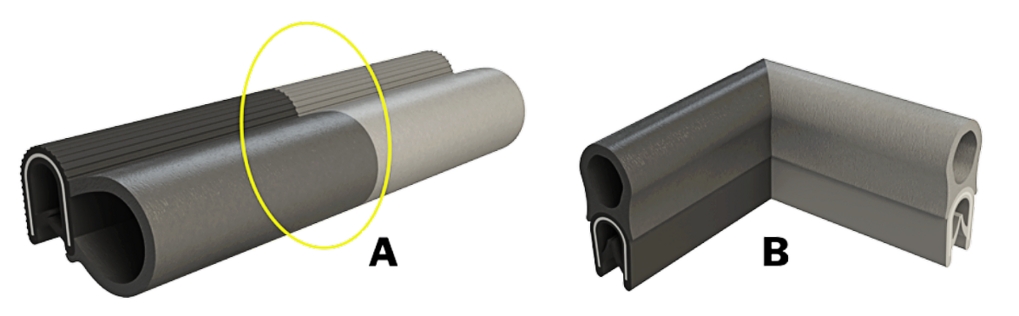
The profiles can be provided with a low-friction coating to prevent the door from sticking to the seal in sub-zero temperatures, or filled with butyl to ensure increased protection against water leakage. Fire-resistant profiles are available that comply with fire protection standards EN45545-2 and UL94HB, or hygienic profiles for food, pharmaceutical and cosmetic applications in accordance with VDI 6022.
Materials and properties
| Material | Natural rubber | Styrene butadiene rubber (Buna™) | Nitrile rubber (Perbunan™) | Chloroprene rubber (Neoprene™) | Ethylene propylene diene rubber (EPDM™) | Fluorine rubber (Viton™) | Methyl silicone rubber (Silopren™) | Polyvinyl chloride (Vestalit™, Vestolit™) |
|---|---|---|---|---|---|---|---|---|
| Abbreviations according to ASTMD 1418 | NR | SBR | NBR | CR | EPDM | FKM | MQ/MVQ | PVC |
| Hardening (Shore A +/-5) | 40-90 | 45-90 | 45-90 | 40-90 | 40-90 | 65-90 | 30-80 | 55-95 |
| Resistance to tearing (N/mm2 ) (B) | 4-15 | 4-15 | 4-14 | 4-15 | 6-13 | O | O | O |
| Spring-back elasticity at 20°C | ++ | + | O | + | + | O | O | |
| Abrasion resistance (B) | ++ | ++ | + | + | + | O | O | O |
| Chemical resistance (A) | + | + | O | + | ++ | ++ | + | ++ |
| Oil resistance (A) | - | - | ++ | + | - | ++ | + | + |
| Fuel resistance (A) | keine | - | + | - | - | ++ | - | - |
| Solvent resistance (A) | - | - | + | + | O | O | + | O |
| Temperature resistance in ºC (C) | -40 to +80 | -30 to +80 | -30 to +100 | -25 to +100 | -40 to +120 | -20 to +200 | -50 to +180 | -25 to +60 |
| Ozone resistance | O | O | O | ++ | ++ | ++ | ++ | O |
| Weather exposure resistance | + | + | + | ++ | ++ | ++ | ++ | + |
| Gas penetration resistance | O | O | + | + | O | O | + | |
| Resistance to permanent deformation (B) | ++ | + | + | + | + | O | O | O |
| Binding to metal | ++ | ++ | O | + | O | O | O | |
| Dielectric qualities | ++ | + | - | O | ++ | + | + | O |
(A) Due to the great number of existing chemicals, possible temperatures and times of exposure, the stated qualities can vary from case to case.
(B) The qualities of the rubber become worse at relatively high or low temperatures.
(C) The stated ranges are accurate under normal circumstances. Extreme strains or environments will make the actual ranges smaller.
++ Perfect or very good.
+ Good.
O Average qualities.
- Poor qualities.